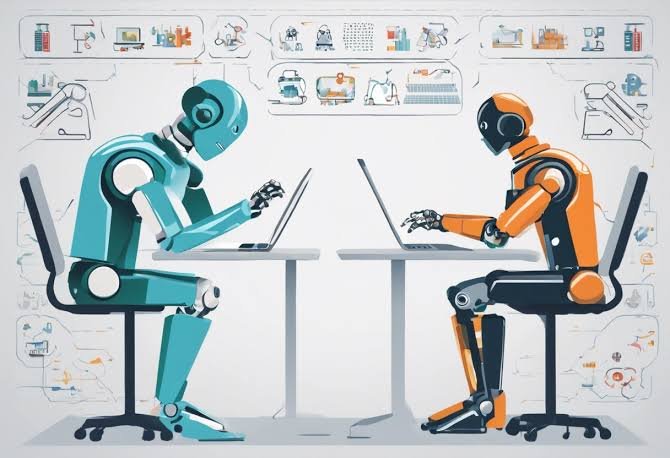
Artificial Intelligence is changing the workplace faster than many people expected.
AI can write text, analyze information, generate images, translate languages, summarize documents, answer questions, assist customers, and automate repetitive tasks. As these technologies become more capable, an important question is being asked around the world:
Will AI replace human workers, or will it create new career opportunities?
The answer is more complicated than simply saying “AI will take everyone’s jobs” or “AI will create more jobs than it destroys.”
Artificial Intelligence is likely to do both.
Some jobs and tasks may disappear or become significantly smaller as automation increases. At the same time, new jobs will emerge, existing professions will change, and workers who know how to use AI effectively may become increasingly valuable.
Understanding this change can help students, employees, business owners, and professionals prepare for the future.
How Is AI Changing Work?
AI has existed for decades, but recent advances have made it much more accessible.
Modern AI systems can perform tasks involving language, images, data analysis, coding, customer service, and decision support.
For businesses, this creates opportunities to automate repetitive processes.
For example, an organization might use AI to:
- Summarize documents
- Answer common customer questions
- Analyze large datasets
- Generate initial drafts
- Sort information
- Detect unusual patterns
- Assist software development
- Create marketing ideas
- Automate administrative tasks
AI does not necessarily replace an entire job when it is introduced.
More often, it initially replaces or assists individual tasks within a job.
This distinction is extremely important.
AI Is More Likely to Replace Tasks Than Entire Jobs
Imagine a marketing professional.
Their job may involve research, writing, meetings, strategy, data analysis, creativity, and communication.
AI might be able to help with research and create an initial draft of marketing copy.
But that does not automatically mean the entire marketing job disappears.
The worker can use the time saved by AI to focus on strategy, understanding customers, developing campaigns, and making decisions.
The same principle applies to many professions.
A lawyer may use AI to review documents.
A programmer may use AI to generate code.
A teacher may use AI to create lesson ideas.
A designer may use AI to explore concepts.
A financial analyst may use AI to summarize reports.
In many cases, the job changes rather than completely disappears.
Which Jobs Could Be Most Affected?
Jobs involving highly repetitive, predictable, and digital tasks are more likely to experience significant AI-driven automation.
Examples could include certain types of:
- Data entry
- Basic administrative work
- Routine customer support
- Document processing
- Transcription
- Simple content production
- Basic data analysis
- Repetitive coding tasks
However, being “affected” does not necessarily mean being eliminated.
AI may reduce the number of people needed for a particular task while increasing demand for workers who can manage, supervise, verify, or improve AI-assisted processes.
Jobs That Require Human Interaction
Jobs involving complex human relationships may be more difficult to fully automate.
Consider professions such as:
- Teachers
- Nurses
- Therapists
- Social workers
- Managers
- Sales professionals
- Consultants
- Skilled tradespeople
These roles often involve empathy, physical interaction, negotiation, trust, judgment, and understanding complicated social situations.
AI can assist these professionals, but replacing the entire human role can be much more difficult.
For example, an AI system might help a teacher create an educational exercise, but classroom teaching also involves motivating students, managing relationships, recognizing emotional needs, and adapting to unexpected situations.
Jobs That Require Creativity
Creative professions are also being affected by AI.
AI can generate text, images, music, video, designs, and other forms of content.
This has raised concerns among writers, artists, designers, photographers, musicians, and other creative professionals.
However, creativity is not simply the ability to produce an output.
Creative work often involves deciding what should be created and why.
A professional designer, for example, does more than produce an image. They understand a client’s goals, audience, brand, communication strategy, and visual identity.
AI can accelerate parts of the creative process, but human direction and judgment remain important.
AI Will Create New Jobs
Technological revolutions often eliminate certain tasks while creating new kinds of work.
The growth of AI is already creating demand for professionals who can build, operate, evaluate, integrate, and govern AI systems.
Some emerging or expanding career areas include:
- AI engineering
- Machine Learning engineering
- AI product management
- AI research
- Data science
- AI safety
- AI governance
- AI cybersecurity
- Automation consulting
- AI training and education
- Data analysis
- AI-assisted content production
Some job titles may change over time, while entirely new roles may emerge that are difficult to predict today.
The Rise of AI-Related Skills
Not everyone needs to become an AI engineer.
One of the most important changes may be the growing value of AI literacy.
AI literacy means understanding what AI can do, what it cannot do, how to use it responsibly, and how to evaluate its results.
A writer does not necessarily need to build a language model.
A lawyer does not need to become a Machine Learning researcher.
A teacher does not need to develop an AI system from scratch.
But professionals in these fields may benefit from understanding how AI tools can support their work.
AI Could Make Workers More Productive
One of the strongest arguments for AI is that it can increase productivity.
Imagine an employee who spends three hours each week performing a repetitive task.
If AI can safely automate much of that task, the employee may be able to spend those three hours on more valuable work.
For example, AI could help prepare a report so that a professional can spend more time interpreting the results.
A programmer could use AI to generate routine code and spend more time designing the overall system.
A writer could use AI to brainstorm ideas and spend more time developing original arguments.
In this way, AI can become a productivity tool rather than simply a replacement technology.
The Importance of Human Judgment
AI systems can be extremely capable, but they can also make mistakes.
They may generate incorrect information, misunderstand context, produce biased results, or confidently provide an answer that sounds convincing but is wrong.
This creates a need for human oversight.
Professionals who understand both their field and AI may therefore become especially valuable.
For example, an AI system might analyze a legal document, but a qualified professional still needs to determine what the analysis means and whether it is legally appropriate.
Similarly, an AI tool might provide medical information, but healthcare professionals are responsible for applying clinical judgment to individual patients.
AI does not eliminate the need for expertise.
In many situations, it increases the importance of knowing when an AI system is wrong.
The Emergence of AI-Augmented Jobs
A useful concept for the future is AI-augmented work.
This means humans and AI systems working together.
Instead of:
Human OR AI
the future may increasingly look like:
Human + AI
Consider a software developer.
The developer may use AI to generate code, identify potential bugs, explain unfamiliar functions, and create tests.
The developer remains responsible for understanding the system, making architectural decisions, reviewing the code, and ensuring that the final product works correctly.
AI becomes a tool that increases the developer’s capabilities.
Similar patterns can occur across many professions.
What About Entry-Level Jobs?
One of the biggest concerns is the effect of AI on entry-level employment.
Many junior workers traditionally learn by performing simpler tasks before taking on more complicated responsibilities.
If AI automates many of those basic tasks, young professionals may have fewer opportunities to gain initial experience.
This could create a challenge for employers and educators.
Companies may need to rethink how they train new employees.
Instead of expecting beginners to learn primarily through repetitive tasks, organizations may need more structured mentorship and training.
For students, this means developing practical skills and learning how to use modern tools effectively may become increasingly important.
Which Skills Will Become More Valuable?
As AI handles more routine tasks, certain human skills may become more valuable.
Critical Thinking
Workers need to evaluate AI-generated information rather than accepting it automatically.
Communication
The ability to explain ideas clearly remains valuable even when AI can generate text.
Creativity
Original ideas, strategic thinking, and problem-solving can help professionals stand out.
Emotional Intelligence
Understanding people and building relationships are difficult to automate completely.
Adaptability
Technology changes quickly, so workers need to learn new tools and adjust their methods.
Domain Expertise
People who deeply understand a specific industry can use AI more effectively because they know how to judge its results.
Will Learning to Use AI Be Enough?
Simply knowing how to type prompts into an AI chatbot is unlikely to be enough to guarantee a successful career.
The most valuable combination is likely to be:
Professional expertise + AI skills + human judgment
For example, an accountant who understands accounting deeply and knows how to use AI tools may have an advantage over someone who knows AI tools but has little understanding of accounting.
Similarly, a journalist with strong research and reporting skills can use AI to speed up certain tasks while maintaining editorial judgment.
AI should complement expertise rather than replace the need to develop expertise.
How Can Students Prepare for an AI-Powered Job Market?
Students entering the workforce should focus on developing both technical and human skills.
Learning basic AI concepts is a useful starting point.
Students can also learn:
- Digital literacy
- Data analysis
- Communication
- Research
- Problem-solving
- Writing
- Presentation skills
- Critical thinking
- Basic programming
- Industry-specific knowledge
It is also useful to experiment with AI tools.
The goal is not to use AI for everything.
Instead, students should learn which tasks AI can improve and which tasks still require careful human involvement.
How Can Professionals Stay Competitive?
Existing workers do not necessarily need to completely change careers because of AI.
A better first step may be to understand how AI affects their current profession.
Ask:
Which parts of my job are repetitive?
Which tasks could AI help with?
What new responsibilities could I take on if AI handles routine work?
For example, an employee who spends significant time creating routine reports might learn how to automate portions of that process.
The time saved could then be used for analysis, client communication, or strategic work.
This turns AI from a threat into a potential productivity advantage.
AI and Entrepreneurship
AI may also lower the barriers to starting a business.
Small teams can use AI tools for tasks that previously required specialized staff.
For example, entrepreneurs can use AI to assist with:
- Market research
- Content creation
- Customer support
- Software development
- Product brainstorming
- Business documentation
- Marketing
- Data analysis
This does not mean businesses can operate without skilled people.
Instead, small teams may be able to accomplish more with fewer resources.
AI could therefore contribute to the creation of new businesses and services.
Potential Problems With AI and Employment
The transition to an AI-driven economy will not necessarily be easy.
Some workers may lose jobs before they have an opportunity to develop new skills.
Certain industries may change faster than educational institutions can adapt.
Income inequality could increase if the benefits of AI are concentrated among a small number of companies or highly skilled workers.
There may also be concerns about workplace surveillance, algorithmic decision-making, bias, and the use of AI to monitor employees.
These challenges mean that technological progress needs to be accompanied by education, responsible business practices, and thoughtful public policy.
Will AI Create More Jobs Than It Eliminates?
Nobody can predict the exact answer with certainty.
The impact will depend on how quickly AI improves, how businesses adopt it, how consumers respond, what regulations are introduced, and what new products and industries emerge.
History provides some reason for optimism.
Previous technological revolutions eliminated certain jobs while creating new occupations and industries.
The personal computer reduced demand for some types of manual office work but created enormous industries around software, IT, digital services, and the internet.
The same could happen with AI.
However, historical comparisons are not perfect. AI can affect cognitive and creative tasks that were previously considered relatively resistant to automation.
The transition could therefore look different from previous technological changes.
The Future May Be About Transformation, Not Replacement
The most realistic future may not be a world where humans stop working and AI does everything.
Instead, many professions could become AI-enhanced professions.
Doctors may use AI for analysis.
Teachers may use AI for lesson preparation.
Engineers may use AI for design and simulation.
Writers may use AI for research and editing.
Programmers may use AI for development assistance.
Accountants may use AI for data analysis.
Managers may use AI for decision support.
The people who learn to work effectively with these systems could become more productive.
What Should People Do Now?
The best response to AI-related uncertainty is not panic.
It is preparation.
Start by learning the basics of AI.
Experiment with reputable tools.
Understand their strengths and limitations.
Develop skills that complement automation.
Build strong communication and critical-thinking abilities.
Most importantly, continue developing expertise in an area you care about.
The future job market will likely reward people who can combine technology with genuine knowledge and human capabilities.
Conclusion
Will AI replace jobs or create new career opportunities?
The most likely answer is both.
AI will automate some tasks and may reduce demand for certain roles. At the same time, it will create new technologies, industries, services, and career opportunities.
The bigger change may be that many existing jobs will be transformed rather than completely eliminated.
Workers will increasingly collaborate with AI systems, using them to automate repetitive tasks, analyze information, generate ideas, and improve productivity.
This means the most important career skill of the future may not be competing against AI.
It may be learning how to work effectively with it.
People who combine AI literacy with communication, creativity, critical thinking, adaptability, and deep professional knowledge will be better positioned to navigate the changing workplace.
AI is not simply a story about machines replacing humans. It is a story about how the relationship between technology and human work is changing.
The future of employment will ultimately depend not only on what AI can do, but on how people, businesses, educators, and governments choose to use it.