Technology is developing faster than ever before. Every year brings new inventions, new digital services, and new ways of solving problems. However, 2026 is particularly important because several technologies that were once considered experimental are moving toward practical, everyday use. Artificial intelligence is becoming more deeply integrated into businesses and consumer products, robots are becoming more capable, cybersecurity is becoming more sophisticated, and quantum computing is moving closer to commercial applications.
The technology trends of 2026 are not happening independently. Artificial intelligence is increasingly combining with robotics, cybersecurity, cloud computing, advanced chips, healthcare, transportation, and scientific research. As a result, technology is becoming more interconnected and more influential in everyday life.
Here are ten major technology trends to watch in 2026.
1. Artificial Intelligence Becomes More Powerful and Practical
Artificial Intelligence, or AI, remains the biggest technology trend of 2026. However, the focus is changing. In previous years, much of the excitement surrounding AI centered on chatbots and generative AI. In 2026, organizations are increasingly focused on using AI to solve practical problems and produce measurable results.
Businesses are using AI to analyze information, automate routine work, assist employees, improve customer service, write software, detect security threats, and support decision-making. AI is also becoming integrated into everyday devices and applications.
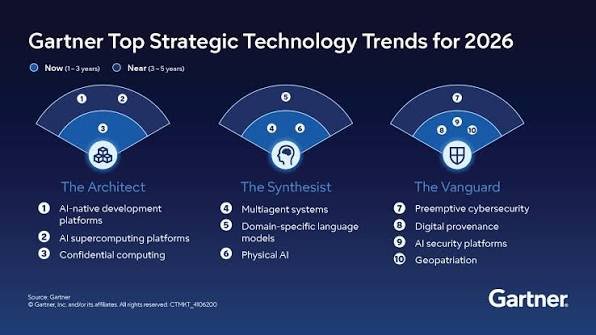
One important development is the movement toward AI-native software development. Instead of programmers writing every part of an application manually, AI tools can help generate code, test software, identify errors, and accelerate development. Gartner identifies AI-native development platforms as one of its major strategic technology trends for 2026. GGartner
The biggest change may therefore be that AI is becoming less of a separate product and more of a basic layer of modern technology.
2. AI Agents and Multiagent Systems
Another major trend is the development of AI agents. Traditional chatbots generally respond to questions or instructions. AI agents are designed to take a series of actions to accomplish a goal.
For example, instead of simply telling a user how to organize a business trip, an AI agent could potentially research flights, compare hotels, organize a schedule, prepare documents, and complete other approved tasks.
In the workplace, multiple AI agents may eventually work together. One agent could analyze data, another could prepare a report, and another could check the results.
Gartner lists multiagent systems among its key 2026 trends, reflecting the growing interest in AI systems that can collaborate to complete complex tasks. GGartner
This could significantly change office work. Instead of using AI only as a question-and-answer tool, employees may increasingly delegate entire workflows to AI systems while remaining responsible for reviewing and approving important decisions.
3. Physical AI and Humanoid Robots
AI is no longer limited to computer screens. A major trend in 2026 is the movement of AI into the physical world through robots, autonomous machines, drones, and intelligent equipment.
This concept is often called physical AI. These systems combine artificial intelligence with sensors, cameras, robotics, and mechanical systems so that machines can understand their surroundings and take physical actions.
Factories and warehouses are already using robots for tasks such as transportation, assembly, sorting, and inspection. More advanced robots are being developed for healthcare, agriculture, manufacturing, logistics, and household tasks.
Humanoid robots are receiving particular attention because their human-like shape could allow them to operate in environments designed for people. However, widespread household use is still a major technological challenge.
Gartner identifies physical AI as a major 2026 trend, while current industry activity shows increasing investment in robotics and physical-world applications. GGartner+1
The important development is not simply the creation of better robots. It is the combination of increasingly capable AI with machines that can physically interact with the world.
4. AI Supercomputing and Advanced Chips
Modern AI requires enormous amounts of computing power. As AI models become larger and more sophisticated, companies and governments are investing heavily in specialized processors, data centers, networking equipment, and energy infrastructure.
AI supercomputing platforms combine powerful processors and specialized hardware to handle demanding workloads such as AI training, scientific simulation, and large-scale data analysis. Gartner lists AI supercomputing platforms among its top strategic technology trends for 2026. GGartner
This means that the future of AI will depend not only on software but also on hardware.
Advanced chips are becoming increasingly important because they can process AI workloads more efficiently. Companies are developing specialized AI processors, while cloud providers are expanding their computing infrastructure.
This trend will affect consumers as well. More computers and smartphones are being designed with dedicated AI processing capabilities, allowing certain AI functions to happen directly on the device rather than entirely in the cloud.
5. Quantum Computing Moves Toward Real-World Applications
Quantum computing has been discussed for many years, but 2026 is an important period for the technology because companies are increasingly moving from theoretical research toward practical applications.
Unlike traditional computers, quantum computers use quantum mechanical principles to perform certain types of calculations. They are not designed to replace ordinary computers, but they could eventually be extremely useful for specialized problems.
Potential applications include drug discovery, materials science, financial modeling, optimization, chemistry, and complex simulations.
According to McKinsey’s 2026 Quantum Technology Monitor, more than 300 companies are already adopting or collaborating around quantum computing, indicating that the technology is moving toward a more commercial phase. MMcKinsey & Company
However, quantum computing is still developing. It would be a mistake to assume that quantum computers will suddenly make today’s computers obsolete. Their value is likely to emerge first in specialized applications where they can provide advantages over classical systems.
6. Cybersecurity Becomes More Proactive
As technology becomes more connected and AI becomes more powerful, cybersecurity becomes increasingly important.
Traditional cybersecurity often focuses on detecting and responding to attacks after suspicious activity occurs. In 2026, organizations are increasingly interested in preemptive cybersecurity—identifying vulnerabilities and potential threats before they cause damage.
AI itself is becoming both a cybersecurity tool and a source of new risks. Security teams can use AI to analyze enormous amounts of activity, identify unusual behavior, detect threats, and respond more quickly.
At the same time, criminals can use AI to create more convincing scams, automate attacks, and generate sophisticated malicious content.
Another emerging concern is quantum computing. Future quantum computers could threaten some of today’s widely used encryption methods, which is why organizations are beginning to adopt post-quantum cryptography designed to withstand quantum attacks. TThe Wall Street Journal
Cybersecurity is therefore becoming a continuous process rather than something companies can address only after an attack.
7. Confidential Computing and Privacy-Preserving Technology
As organizations use more AI and cloud services, protecting sensitive information becomes increasingly important.
One technology receiving greater attention in 2026 is confidential computing. It is designed to protect data while it is being processed, not just when it is stored or transmitted.
This can be especially valuable for industries such as healthcare, finance, government, and business, where sensitive information must be handled securely.
Gartner identifies confidential computing as one of its major technology trends for 2026 and expects its importance to grow as organizations process sensitive workloads across cloud and other infrastructure. GGartner
Privacy-preserving technology may become particularly important as AI systems gain access to larger amounts of personal and organizational information.
The challenge will be to gain the benefits of AI and cloud computing without sacrificing privacy and security.
8. Digital Provenance and the Fight Against Misinformation
Generative AI has made it easier than ever to create convincing text, photographs, audio, and video. While this has many positive applications, it also makes misinformation and fake content more difficult to identify.
This is why digital provenance is becoming an important technology trend.
Digital provenance refers to methods for establishing where digital content came from, how it was created, and whether it has been modified. Such systems could help users determine whether a photograph is authentic, whether a document has been altered, or whether content was generated or manipulated by AI.
Gartner includes digital provenance among its strategic technology trends for 2026. GGartner
This could become increasingly important in journalism, education, business, government, and social media.
In the future, simply asking whether something “looks real” may not be enough. People may increasingly rely on technical information about the origin and history of digital content.
9. Smarter Healthcare and Biotechnology
Technology is also transforming medicine and biotechnology. AI can help researchers analyze enormous amounts of biological and medical information, identify patterns, and explore potential treatments.
AI-assisted systems can support medical professionals in areas such as medical imaging, research, documentation, and patient information management. Meanwhile, biotechnology companies are using advanced computing to study proteins, diseases, drugs, and biological processes.
The combination of AI with biotechnology could accelerate the development of new medicines and improve our understanding of complex diseases.
The broader trend is the convergence of digital technology and biology. AI can process information at a scale that would be difficult for humans to handle manually, while advances in biotechnology provide new sources of data and new opportunities for scientific discovery.
However, healthcare technology must be developed carefully because errors can have serious consequences. Human expertise, clinical testing, privacy protection, and regulation remain essential.
10. Smarter and More Connected Devices
The final major trend is the continued development of smart devices and connected environments.
Smartphones, watches, cars, home appliances, cameras, televisions, and other devices are becoming increasingly intelligent. Many can now process information locally, respond to voice commands, understand user behavior, and communicate with other devices.
In 2026, AI is increasingly being built directly into consumer hardware. This can make devices faster and more personalized while also allowing certain information to be processed locally.
Smart homes are another example. Appliances can monitor energy consumption, optimize their operation, and respond to user preferences. Wearable devices can collect information about activity and provide increasingly sophisticated insights.
The goal is gradually shifting from having many separate smart devices to creating connected environments in which devices can work together.
How These Trends Will Affect Our Lives
These ten technology trends are likely to influence everyday life in several ways.
At work, AI agents and AI-powered software may automate repetitive tasks and help employees become more productive. In homes, intelligent appliances and robots may make certain everyday activities easier. In healthcare, AI and biotechnology could improve research and medical services. In transportation, intelligent systems may make vehicles safer and more efficient.
At the same time, people will need to adapt to new challenges.
Workers may need to develop new skills as AI changes their jobs. Consumers will need to become more aware of privacy and cybersecurity. Schools will need to teach students how to use AI responsibly. Governments and organizations will need to establish rules that encourage innovation while protecting people from serious risks.
The most important skill of the future may therefore not be knowing how to use one particular technology. It may be the ability to continuously learn and adapt.
Conclusion
The technology landscape of 2026 is being shaped by a powerful combination of artificial intelligence, advanced computing, robotics, cybersecurity, biotechnology, and connected devices.
AI remains at the center of many of these developments, but the next stage is about much more than chatbots. AI agents are beginning to perform complex tasks, robots are bringing intelligence into the physical world, specialized computing is supporting increasingly powerful AI systems, and quantum computing is moving toward practical applications.
At the same time, cybersecurity, privacy, digital trust, and responsible technology development are becoming just as important as innovation itself.
The future will not be determined by technology alone. It will be determined by how people, businesses, governments, and communities choose to use it. The greatest opportunities will come from technologies that solve real problems and improve people’s lives, while the greatest challenges will come from using powerful technologies without sufficient responsibility.
As we move through 2026 and beyond, one thing is clear: technology is no longer simply changing the devices around us. It is changing the way society works. Understanding these trends today can help individuals and organizations prepare for the opportunities—and challenges—of tomorrow.