Technology is changing the way people experience the world around them. We can communicate with people thousands of miles away, access information instantly, and use powerful digital tools from devices that fit in our pockets.
Two technologies that are creating especially interesting possibilities are Virtual Reality (VR) and Augmented Reality (AR).
Both technologies combine the physical and digital worlds in new ways, but they work very differently.
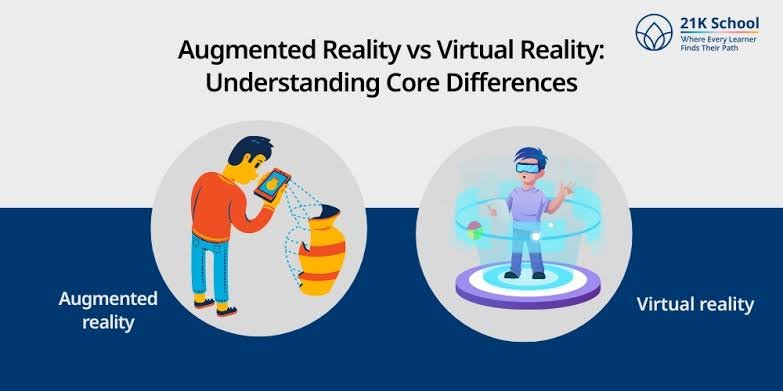
Virtual Reality attempts to place users inside a completely digital environment. Augmented Reality, on the other hand, adds digital information or objects to the real world.
Both have applications in gaming, education, healthcare, business, entertainment, manufacturing, and many other industries.
So, what exactly is the difference between VR and AR? Which technology is better? And what could the future of immersive technology look like?
This beginner-friendly guide explains everything you need to know.
What Is Virtual Reality?
Virtual Reality is a technology that creates a simulated digital environment designed to make users feel as though they are inside another world.
Users typically wear a VR headset containing displays and sensors.
The headset shows digital images separately to each eye, creating a sense of depth.
As the user moves their head, sensors can detect the movement and adjust the virtual scene.
This creates the feeling that you are looking around inside a three-dimensional environment.
A VR system may also include controllers that allow users to interact with virtual objects.
For example, you could use a VR headset to explore a virtual museum, play a game, practice a job, or visit a simulated location.
What Is Augmented Reality?
Augmented Reality adds digital information to the physical world.
Instead of completely replacing your surroundings, AR keeps the real world visible while placing digital elements on top of it.
A simple example is a smartphone camera application that places virtual objects into a real room.
AR can also display information such as directions, labels, instructions, or notifications.
You may already have used AR without realizing it.
Many smartphone applications use cameras and sensors to recognize the physical environment and add digital content.
VR vs. AR at a Glance
The easiest way to understand the difference is:
VR replaces your surroundings with a digital environment.
AR adds digital information to your existing surroundings.
| Feature | Virtual Reality | Augmented Reality |
|---|---|---|
| Environment | Mostly virtual | Real + digital |
| Typical hardware | VR headset | Phone, glasses, or AR headset |
| Blocks real-world view? | Usually | Usually not |
| Main experience | Immersive simulation | Digital enhancement |
| Common uses | Gaming, training, simulation | Navigation, education, shopping |
| Interaction | Controllers, hand tracking, body movement | Touch, gestures, voice, cameras |
Neither technology is necessarily better.
They are designed for different purposes.
How Does Virtual Reality Work?
VR requires several technologies to work together.
Head-Mounted Display
The headset contains screens positioned close to the user’s eyes.
These displays create the visual environment.
Motion Tracking
Sensors track head and sometimes body movement.
If you turn your head, the virtual environment changes accordingly.
Controllers
Many VR systems use handheld controllers to allow users to interact with virtual objects.
Modern systems may also use cameras or sensors to track hands directly.
Audio
Spatial audio can make virtual environments feel more realistic by creating the impression that sounds are coming from specific directions.
Together, these technologies create an immersive experience.
How Does Augmented Reality Work?
AR also uses cameras, sensors, processors, and displays.
A device first needs to understand aspects of the user’s surroundings.
For example, it may detect surfaces, objects, movement, or the user’s location.
The system then places digital information in an appropriate position.
Imagine pointing your phone at an empty floor and seeing a virtual chair appear on the screen.
The AR system needs to estimate where the floor is and position the digital chair accordingly.
More advanced AR devices can perform this process continuously.
VR in Gaming
Gaming is one of the most popular applications of Virtual Reality.
Traditional video games display a virtual world on a screen.
VR places the player inside that world.
Instead of controlling a character from outside, the player can look around and interact with the environment directly.
VR can make games feel much more immersive.
It is particularly effective for genres involving exploration, simulation, racing, fitness, and action.
However, VR gaming can also require significant hardware and physical space.
Some users may experience motion sickness when visual movement does not match physical movement.
AR in Gaming
AR can create a different type of gaming experience.
Instead of transporting the player into a completely virtual environment, AR places digital game elements into the real world.
A player might see virtual characters or objects through a smartphone or AR glasses.
This can encourage players to move around their physical surroundings.
AR games can therefore combine digital entertainment with real-world exploration.
Virtual Reality in Education
VR can provide students with immersive learning experiences.
Instead of simply reading about ancient civilizations, students could potentially explore a virtual historical environment.
Science students could examine simulated environments that would be difficult, expensive, or dangerous to visit physically.
VR can also support practical training.
For example, students could practice procedures repeatedly in a simulated environment before working with real equipment.
This does not mean VR should replace traditional education.
Instead, it can provide another tool for learning.
Augmented Reality in Education
AR can also make educational material interactive.
Imagine pointing a smartphone or AR glasses at a textbook illustration and seeing a three-dimensional model appear.
Students could potentially examine:
- Human anatomy
- Planets
- Machines
- Historical objects
- Chemical structures
- Architectural designs
Instead of viewing information only as text or a flat image, learners could interact with digital models.
This can make certain concepts easier to visualize.
VR in Healthcare
Healthcare is another promising application for VR.
Medical professionals can use simulated environments for training.
Students can practice procedures without immediately working with real patients.
VR may also have applications in rehabilitation, pain management, mental-health treatments, and surgical planning.
The effectiveness of a specific application depends on the medical condition, technology, and clinical evidence.
VR should therefore be considered a potential medical tool rather than a universal treatment.
AR in Healthcare
AR can assist medical professionals by displaying information while keeping the real environment visible.
For example, an AR system could potentially show anatomical information or procedural guidance over a patient’s body.
Surgeons and medical students could use visual overlays to better understand complex structures.
The ability to access information without completely removing attention from the physical environment is one of AR’s major advantages.
VR and Employee Training
Businesses can use VR to train employees in realistic simulations.
This can be particularly useful when training involves expensive equipment, dangerous environments, or rare situations.
For example, employees could practice emergency procedures in a virtual environment.
Companies can repeat the same training scenario multiple times without requiring physical equipment or exposing workers to real-world danger.
VR can therefore reduce some training costs while increasing opportunities for practice.
AR in the Workplace
AR can provide workers with instructions while they perform tasks.
For example, a technician repairing equipment could potentially wear AR glasses that display step-by-step instructions.
An engineer could see information about a machine without constantly looking away to consult a manual.
Warehouse workers could receive navigation or product information through AR systems.
This concept is sometimes described as hands-free information access.
VR and Travel
Virtual Reality could change the way people experience destinations.
A traveler could take a virtual tour of a hotel, museum, landmark, or destination before deciding whether to visit.
People who cannot travel physically could also explore virtual environments from home.
VR will not completely replace real travel because physical experiences involve factors such as food, weather, culture, social interaction, and physical surroundings.
However, it could become a valuable supplement.
AR and Navigation
AR can make navigation more intuitive.
Instead of looking at a traditional map, a user could potentially see directional information overlaid onto the real environment.
For example, arrows could appear on a street through a smartphone camera or AR glasses.
This could make it easier to understand which direction to walk.
Future AR glasses could potentially make navigation feel more natural by providing information directly in the user’s field of view.
Shopping With AR
AR is already being explored in retail.
One useful application is virtual product visualization.
For example, someone buying furniture could use an AR application to see what a virtual sofa would look like in their living room.
Customers could potentially visualize:
- Furniture
- Paint colors
- Clothing
- Accessories
- Home decorations
- Consumer products
This can reduce uncertainty when buying products online.
Virtual Shopping and VR
VR can take online shopping in a different direction.
Instead of looking at products on a flat webpage, shoppers could potentially enter a virtual store.
They might examine products in a three-dimensional environment.
Retailers could eventually create virtual showrooms where customers interact with products in ways that resemble physical shopping.
However, traditional websites and mobile applications remain simpler for many purchases.
Which Technology Is More Immersive?
VR generally provides a more immersive experience because it attempts to replace the user’s visual environment.
AR is less isolating because it keeps the real world visible.
This difference makes VR useful for situations where complete immersion is desirable.
AR is often better when users need to interact with their physical surroundings while receiving digital information.
What About Mixed Reality?
You may also hear the term Mixed Reality (MR).
Mixed Reality generally refers to experiences where physical and digital objects interact or are integrated more closely than in simple AR overlays.
For example, a virtual object could appear anchored to a real table and respond to the user’s movements or surroundings.
The boundaries between AR, MR, and other immersive technologies are not always perfectly defined.
Manufacturers and developers sometimes use these terms differently.
Advantages of Virtual Reality
VR offers several potential benefits.
Immersion
Users can feel deeply involved in digital environments.
Simulation
It can recreate environments that are difficult or dangerous to access.
Training
Workers and students can practice scenarios repeatedly.
Entertainment
VR creates new possibilities for gaming and interactive storytelling.
Visualization
Complex environments can be explored in three dimensions.
Disadvantages of Virtual Reality
VR also has limitations.
Cost
High-quality equipment can be expensive.
Physical Space
Some experiences require enough room for movement.
Motion Sickness
Some users experience discomfort or nausea.
Isolation
Because VR can block the surrounding environment, users may become less aware of people and objects around them.
Hardware Requirements
Some applications require powerful computers or advanced headsets.
Advantages of Augmented Reality
AR has a different set of strengths.
Real-World Awareness
Users can continue seeing their surroundings.
Accessibility
Smartphone-based AR does not necessarily require specialized hardware.
Practical Information
Digital information can be displayed directly in context.
Navigation
AR can enhance directions and location-based information.
Product Visualization
Customers can see how digital representations might look in real environments.
Disadvantages of Augmented Reality
AR also faces challenges.
Limited Field of View
Some AR devices cannot display digital content across a large portion of the user’s vision.
Hardware Challenges
Developing lightweight, comfortable AR glasses is difficult.
Privacy
AR glasses with cameras could raise concerns about recording people without their knowledge.
Battery Life
Small wearable devices need to balance processing power with battery size.
Accuracy
AR systems must correctly understand physical surroundings to position digital content effectively.
VR vs. AR: Which One Should You Choose?
The answer depends on what you want to do.
Choose VR if you want:
- Highly immersive gaming
- Virtual travel
- Simulated training
- Virtual exploration
- Immersive entertainment
- Fitness experiences
Choose AR if you want:
- Navigation
- Product visualization
- Real-world instructions
- Interactive learning
- Workplace assistance
- Digital information layered onto physical surroundings
For some applications, both technologies could be useful.
The Future of VR and AR
The future of immersive technology could be significantly different from today’s experience.
Headsets may become lighter, thinner, and more comfortable.
AR glasses could eventually look more like ordinary glasses.
Better sensors could allow devices to understand physical environments more accurately.
Artificial Intelligence could make virtual characters and environments more responsive.
Cloud computing could provide additional processing power.
Faster wireless networks could improve remote and collaborative experiences.
These technologies could eventually converge into systems where the boundary between digital and physical experiences becomes increasingly blurred.
The Future of Work
Immersive technology could change how people work.
Instead of communicating primarily through video calls, teams could meet in shared virtual environments.
Engineers could collaborate on three-dimensional designs.
Architects could walk through virtual buildings before construction.
Technicians could receive real-time instructions through AR glasses.
Remote employees could interact with digital workspaces in new ways.
The challenge will be making these systems comfortable, affordable, secure, and genuinely useful.
The Future of Entertainment
Entertainment could become increasingly interactive.
Movies may evolve into experiences where viewers can explore environments.
Concerts could include virtual and augmented experiences.
Sports fans might receive real-time statistics through AR glasses.
Video games could become more immersive and physically interactive.
Instead of simply watching digital content, people may increasingly participate in it.
Privacy and Security Concerns
As VR and AR become more advanced, privacy will become increasingly important.
These devices can potentially collect information about:
- Locations
- Movements
- Physical surroundings
- Voice
- Eye movements
- Hand movements
- User interactions
AR glasses with cameras may also capture information about other people.
Companies and users will therefore need strong privacy and security practices.
The technology should be designed so that people understand what information is being collected and how it is used.
Conclusion
Virtual Reality and Augmented Reality are two related but fundamentally different technologies.
VR creates an immersive digital environment that can replace much of the user’s view of the real world.
AR adds digital information and objects to the physical environment while keeping the real world visible.
VR is particularly powerful for immersive gaming, simulation, training, education, and entertainment.
AR is especially useful for navigation, workplace assistance, education, shopping, and applications where digital information needs to be connected to the physical world.
Neither technology is automatically better.
The most important factor is the problem being solved.
As hardware improves and Artificial Intelligence becomes more capable, VR and AR could become more natural parts of everyday life.
The future may not involve choosing between the real world and the digital world. Instead, technologies such as AR, VR, AI, and wearable devices may increasingly allow the two to work together.