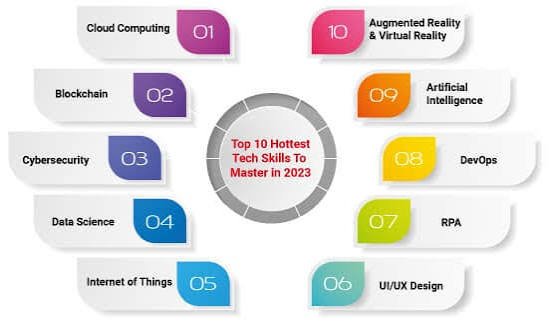
Technology has become an important part of almost every modern career.
You do not need to be a software engineer or computer scientist to benefit from technology skills. Teachers use digital learning platforms, marketers use analytics tools, accountants work with financial software, healthcare professionals use digital records, and business managers rely on online collaboration systems.
As Artificial Intelligence, cloud computing, cybersecurity, automation, and data-driven decision-making continue to develop, technology skills are becoming increasingly valuable across industries.
The good news is that you do not need to learn every technology available. Instead, focusing on a core set of practical skills can help you become more productive, adaptable, and competitive in the job market.
This guide explores 10 essential technology skills that can help students, job seekers, and professionals build a successful career.
Why Are Technology Skills Important?
Technology changes quickly.
Tools that were considered advanced a few years ago may now be standard workplace software.
At the same time, completely new technologies can create new careers and change existing ones.
Employers increasingly value people who can use technology to solve problems rather than simply perform routine tasks.
Technology skills can help you:
- Work more efficiently
- Communicate effectively
- Analyze information
- Protect digital information
- Automate repetitive tasks
- Collaborate remotely
- Adapt to new tools
- Make better decisions
- Improve productivity
- Discover new career opportunities
You do not need to master all of these skills at an expert level.
A combination of basic knowledge and practical experience can already provide significant benefits.
1. Digital Literacy
The first technology skill everyone should develop is digital literacy.
Digital literacy means understanding how to use computers, smartphones, online services, applications, and digital information effectively and responsibly.
Basic digital literacy includes knowing how to:
- Manage files and folders
- Use web browsers
- Search for information
- Install and update software
- Use email
- Work with documents and spreadsheets
- Participate in video meetings
- Manage online accounts
- Recognize suspicious digital activity
Digital literacy may sound basic, but it is the foundation for almost every other technology skill.
Someone who understands fundamental digital concepts can learn new software much more easily.
How to Improve Digital Literacy
Practice using different types of software.
Learn basic keyboard shortcuts.
Understand file formats and cloud storage.
Become comfortable troubleshooting simple problems.
Most importantly, develop the habit of exploring unfamiliar technology instead of avoiding it.
2. Artificial Intelligence Literacy
Artificial Intelligence is rapidly becoming part of the modern workplace.
You do not necessarily need to become an AI researcher, but understanding the basics of AI is increasingly useful.
AI literacy includes understanding:
- What AI is
- How Machine Learning works at a basic level
- What AI tools can do
- What their limitations are
- How to verify AI-generated information
- How to use AI responsibly
- How AI can improve your workflow
Professionals can use AI tools for tasks such as brainstorming, summarization, research assistance, data analysis, writing support, coding assistance, and automation.
However, AI-generated information can be inaccurate.
That makes critical thinking an essential companion skill.
The goal is not to blindly rely on AI.
The goal is to know when and how to use it effectively.
3. Data Analysis
Modern organizations generate enormous amounts of data.
Companies collect information about customers, sales, operations, marketing, finances, products, and employees.
The ability to understand and analyze data can therefore be valuable in almost every industry.
You do not necessarily need to become a professional data scientist.
Start with basic concepts such as:
- Tables
- Charts
- Percentages
- Averages
- Trends
- Data filtering
- Sorting
- Basic statistics
Spreadsheet software is an excellent place to begin.
Learn how to use formulas, pivot tables, charts, and basic data-cleaning techniques.
As you become more advanced, you can explore tools such as SQL, Python, or specialized data-analysis platforms.
Why Data Skills Matter
Data can help businesses answer questions such as:
“Which products are selling best?”
“Where are customers coming from?”
“Why are costs increasing?”
“Which marketing campaign performs better?”
Professionals who can turn raw information into useful insights can provide significant value to organizations.
4. Cybersecurity Awareness
Cybersecurity is no longer only an IT department issue.
Every employee who uses a computer, smartphone, email account, or online service has some responsibility for digital security.
Basic cybersecurity skills include understanding:
- Strong passwords
- Password managers
- Multi-factor authentication
- Phishing
- Malware
- Software updates
- Secure Wi-Fi
- Data protection
- Safe browsing
For example, an employee who recognizes a phishing email can prevent a potentially serious security incident.
Good cybersecurity habits protect both individuals and organizations.
How to Build Cybersecurity Skills
Start by securing your own digital life.
Use unique passwords.
Enable multi-factor authentication.
Keep software updated.
Learn how phishing attacks work.
Understand how to recognize suspicious messages.
Once you understand the basics, you can explore more advanced cybersecurity topics if they are relevant to your career.
5. Cloud Computing
Cloud computing has changed how businesses store data, run software, and provide digital services.
Instead of relying entirely on computers and servers located inside an office, organizations can use computing resources provided through the internet.
Cloud services can provide:
- Storage
- Databases
- Software
- Computing power
- Backup systems
- Collaboration tools
- Application hosting
Popular cloud platforms include services from companies such as Amazon Web Services, Microsoft, and Google.
You do not need to become a cloud engineer to understand the basics.
Knowing concepts such as cloud storage, Software as a Service, remote collaboration, backups, and cloud security can be useful in many careers.
6. Communication and Collaboration Tools
Modern workplaces increasingly depend on digital communication.
Employees may work from different cities, countries, or even continents.
Technology skills therefore include knowing how to communicate professionally through digital platforms.
This can include:
- Video conferencing
- Team messaging
- Shared documents
- Project-management platforms
- Online calendars
- Digital presentations
Technical ability alone is not enough.
You also need to understand digital communication etiquette.
Write clear messages.
Keep meetings focused.
Organize shared files.
Respect other people’s time.
Use the appropriate communication channel for each situation.
Technology is valuable when it improves communication rather than creating unnecessary noise.
7. Basic Programming
You do not have to become a professional programmer to benefit from learning basic coding.
Programming teaches you how to break complex problems into smaller steps.
This way of thinking can be useful even when you never work as a developer.
Learning a programming language such as Python can introduce concepts including:
- Variables
- Conditions
- Loops
- Functions
- Data structures
- Automation
- Problem-solving
Basic programming can also help you automate repetitive tasks.
For example, a simple script might process files, organize data, or perform repetitive calculations.
Programming knowledge can also help non-technical professionals communicate more effectively with developers and understand what software can realistically do.
8. Automation
Automation is becoming increasingly important as organizations look for ways to reduce repetitive work.
Automation means using technology to perform tasks with limited human intervention.
Examples include:
- Automatically organizing files
- Sending scheduled emails
- Generating reports
- Updating spreadsheets
- Moving information between applications
- Processing routine requests
Automation does not necessarily require advanced programming.
Many modern tools provide visual interfaces that allow users to create workflows.
The key skill is recognizing repetitive tasks that can be improved through automation.
Ask yourself:
Do I perform this task repeatedly?
Does it follow predictable rules?
Could software perform some or all of it?
If the answer is yes, automation may be worth exploring.
9. Problem-Solving and Troubleshooting
Technology skills are not only about knowing how to use software.
You also need to know what to do when technology does not work.
Basic troubleshooting can save time and reduce dependence on others.
A good troubleshooting process might involve:
- Clearly identifying the problem.
- Determining what changed.
- Testing possible causes.
- Searching reliable documentation.
- Trying one solution at a time.
- Checking whether the solution worked.
- Recording the solution if the problem may happen again.
This approach applies to everything from a printer that will not connect to a software application producing unexpected results.
Problem-solving is especially valuable because new technologies are constantly appearing.
You cannot memorize the solution to every possible problem.
Instead, you need to know how to find and evaluate solutions.
10. Adaptability and Continuous Learning
Perhaps the most important technology skill is the ability to learn new technology.
Technology changes too quickly for anyone to master everything.
A software tool you learn today may be redesigned tomorrow.
New AI systems may change how an entire profession works.
New cybersecurity threats may require new defensive techniques.
New platforms may replace older ones.
This means adaptability is essential.
A successful technology learner does not ask:
“Do I already know this tool?”
They ask:
“How quickly can I understand and use this tool?”
How to Become a Continuous Learner
Set aside regular time for learning.
Take online courses.
Read documentation.
Watch practical tutorials.
Experiment with new tools.
Build small projects.
Ask questions.
Most importantly, practice what you learn.
Reading about technology is useful, but actually using it develops much stronger skills.
How These Skills Work Together
The real value comes from combining these skills.
Imagine a marketing professional who understands:
- Digital tools
- AI
- Data analysis
- Automation
- Cybersecurity
- Communication
That person could potentially use AI to generate initial ideas, analyze campaign data, automate repetitive reporting, communicate results to a team, and protect customer information.
The same principle applies to other professions.
A teacher could combine AI, data analysis, digital collaboration, and cybersecurity.
A business owner could combine cloud computing, automation, data analysis, and digital marketing.
A healthcare professional could combine digital literacy, cybersecurity awareness, data skills, and AI literacy.
Technology becomes more powerful when different skills are combined.
Technical Skills vs. Soft Skills
Technology skills are important, but they are only one part of career success.
Employers also value skills such as:
- Communication
- Teamwork
- Leadership
- Creativity
- Critical thinking
- Emotional intelligence
- Time management
- Adaptability
The strongest professionals combine technical and human abilities.
For example, knowing how to analyze data is useful.
But being able to explain what the data means to other people is even more valuable.
Knowing how to use AI is useful.
Knowing when not to use AI can be equally important.
Which Technology Skills Should You Learn First?
If you are a complete beginner, do not try to learn everything simultaneously.
A practical learning path could be:
Step 1: Digital Literacy
Become comfortable with computers, files, browsers, email, and common applications.
Step 2: Productivity Tools
Learn documents, spreadsheets, presentations, calendars, and collaboration software.
Step 3: AI Literacy
Learn how modern AI tools work and how to evaluate their results.
Step 4: Data Skills
Learn spreadsheets, charts, basic statistics, and eventually SQL or Python if relevant.
Step 5: Cybersecurity
Learn how to protect accounts, devices, and information.
Step 6: Automation
Identify repetitive tasks and learn how to automate them.
Step 7: Programming
If your career requires deeper technical knowledge, begin learning a programming language.
This approach allows you to build skills gradually.
How to Demonstrate Technology Skills to Employers
Simply listing technology skills on a résumé is not always enough.
Whenever possible, demonstrate what you can actually do.
For example, instead of writing:
“Advanced data skills”
you could describe a project where you analyzed a dataset and created a dashboard.
Instead of simply writing:
“AI experience”
you could explain how you used AI to improve a workflow while verifying the accuracy of the results.
Projects provide evidence that you can apply your knowledge.
Build a Technology Portfolio
A portfolio can be especially useful for students and people entering technology-related careers.
Your portfolio could include:
- Data-analysis projects
- Websites
- Automation workflows
- Programming projects
- Presentations
- Research projects
- AI-assisted projects
- Digital designs
The projects do not need to be enormous.
A small project that solves a real problem can demonstrate valuable skills.
The Importance of Learning How to Learn
Technology changes so quickly that learning itself becomes a career skill.
You should become comfortable with:
- Reading documentation
- Searching for reliable information
- Comparing different solutions
- Testing unfamiliar software
- Learning from mistakes
- Asking effective questions
- Updating your knowledge
This allows you to remain useful even when specific tools become outdated.
A programming language may change.
An AI platform may disappear.
A cloud service may introduce new features.
But the ability to learn remains valuable.
Technology Skills and the Future of Work
Artificial Intelligence and automation are likely to change many professions.
Some tasks will become automated.
Other tasks will become more valuable.
Workers who understand technology may be better positioned to adapt.
The future workplace is likely to involve increasing collaboration between people and intelligent software.
This means technology skills will not necessarily be limited to technology companies.
They will increasingly become part of ordinary professional work.
Final Thoughts
Technology skills are no longer optional extras for many careers.
From basic digital literacy to Artificial Intelligence, cybersecurity, data analysis, cloud computing, programming, and automation, technology can help professionals work more efficiently and adapt to change.
However, you do not need to master everything.
Start with the fundamentals.
Choose skills that are relevant to your career.
Practice them through real projects.
Stay curious.
Most importantly, develop the ability to learn new technology quickly.
The technology landscape will continue changing, but one principle is unlikely to change:
People who can combine technology with strong human judgment, communication, creativity, and problem-solving will be well prepared for the future of work.