Technology is becoming increasingly connected. Today, your smartphone can communicate with your smartwatch, your car can connect to the internet, your home thermostat can adjust itself automatically, and factories can use sensors to monitor machines in real time.
This growing network of connected physical objects is known as the Internet of Things, or IoT.
The Internet of Things is changing the way people interact with technology. Instead of computers and smartphones being the only devices connected to the internet, everyday objects can now collect information, communicate with other systems, and sometimes make decisions automatically.
IoT is already used in homes, businesses, healthcare, transportation, agriculture, manufacturing, and many other industries.
But what exactly is IoT? How does it work? What are its benefits and risks? And what could the future of connected devices look like?
This beginner-friendly guide explains the Internet of Things in simple terms.
What Is the Internet of Things?
The Internet of Things (IoT) refers to a network of physical objects that are connected to the internet or another network and can collect, exchange, or process data.
These objects are often called IoT devices.
An IoT device can be almost anything that contains some combination of sensors, software, processing capabilities, and network connectivity.
Examples include:
- Smart thermostats
- Smart watches
- Fitness trackers
- Connected cars
- Smart refrigerators
- Security cameras
- Smart doorbells
- Industrial machines
- Medical devices
- Agricultural sensors
- Smart lighting systems
- Environmental sensors
The key idea is simple: physical objects can collect information and communicate digitally.
A Simple Example of IoT
Imagine a smart thermostat in your home.
A traditional thermostat might simply allow you to set a temperature manually.
A smart thermostat can contain sensors that measure temperature and other environmental information. It can connect to the internet and communicate with a smartphone application.
You might be able to adjust the temperature remotely from your phone.
The thermostat could also learn patterns in your schedule and automatically adjust the temperature.
This is a basic example of the Internet of Things: a physical object collects information, communicates with other systems, and performs actions based on data.
How Does IoT Work?
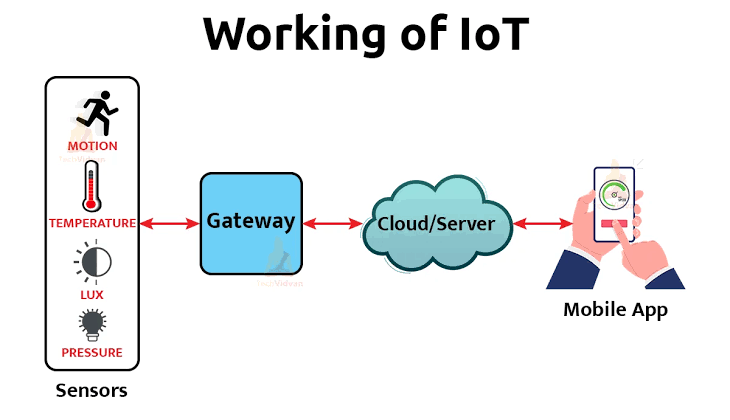
An IoT system usually involves several important components.
1. Sensors
Sensors collect information from the physical environment.
Depending on the device, sensors can measure:
- Temperature
- Humidity
- Movement
- Light
- Location
- Pressure
- Sound
- Heart rate
- Air quality
For example, a smart agricultural sensor might measure the moisture level in soil.
2. Connectivity
Once information is collected, the device needs a way to transmit it.
IoT devices can use different communication technologies, including:
- Wi-Fi
- Bluetooth
- Cellular networks
- 5G
- Ethernet
- Zigbee
- Other specialized wireless technologies
The appropriate technology depends on the device and its environment.
3. Data Processing
The collected information needs to be processed.
Some processing can happen directly on the device. This is known as edge computing or edge processing.
Other data can be sent to a server or cloud platform where more powerful computers analyze it.
For example, a fitness tracker may collect movement information and send it to a smartphone, which then synchronizes the information with a cloud service.
4. Software and Applications
Users need a way to interact with IoT devices.
This might be a smartphone application, website, computer dashboard, or automated system.
For example, a smart security camera could send an alert to your smartphone when it detects movement.
The application allows you to view the camera, receive notifications, and change settings.
5. Action
The final step is often an action.
After collecting and processing information, an IoT system can respond automatically.
For example, a smart thermostat can turn heating or cooling on or off.
A smart light can switch on when motion is detected.
An industrial system could alert technicians when a machine shows signs of a potential problem.
This creates a cycle:
Sense → Communicate → Process → Act
That cycle is at the heart of many IoT systems.
Examples of IoT in Everyday Life
IoT is already present in many people’s daily routines.
Smart Homes
Smart-home technology is one of the most familiar examples of IoT.
Smart devices can include:
- Lights
- Thermostats
- Door locks
- Cameras
- Doorbells
- Speakers
- Appliances
- Smoke detectors
These devices can communicate with smartphones and with each other.
For example, a smart-home system could automatically turn lights on when someone enters a room.
A smart doorbell could detect movement and send a notification to a smartphone.
A smart thermostat could adjust the temperature based on schedules or sensor information.
Wearable Devices
Smartwatches and fitness trackers are another major IoT category.
Wearable devices can collect information such as activity levels, movement, heart rate, sleep patterns, and other measurements depending on the device.
This information can be displayed on the wearable itself or synchronized with a smartphone and online service.
Wearable technology demonstrates how IoT can connect physical devices with digital information.
Connected Cars
Modern vehicles increasingly contain sensors, computers, GPS systems, and internet connectivity.
Connected cars can provide navigation, traffic information, emergency services, remote features, software updates, and vehicle diagnostics.
Some vehicles can send information to manufacturers or service providers to help identify potential maintenance issues.
As connected and automated vehicle technologies develop, IoT will play an increasingly important role in transportation.
IoT in Healthcare
Healthcare is another important area for IoT.
Connected medical devices can monitor patients and collect information that healthcare professionals can use.
Examples can include remote monitoring systems, connected medical equipment, wearable health devices, and hospital asset-tracking systems.
IoT can potentially allow certain health information to be collected outside traditional healthcare settings.
However, healthcare IoT requires particularly strong privacy, security, reliability, and regulatory protections because health information is highly sensitive.
IoT in Agriculture
Farmers can use connected sensors to collect information about crops and environmental conditions.
Sensors can monitor:
- Soil moisture
- Temperature
- Humidity
- Weather conditions
- Water usage
- Equipment status
This information can help farmers make more informed decisions.
For example, an irrigation system could use soil-moisture information to determine when crops need water.
IoT can therefore contribute to more efficient use of resources.
IoT in Manufacturing
Manufacturing is one of the most important industrial applications of IoT.
Factories can use sensors to monitor machinery and production systems.
Instead of waiting for a machine to fail, companies can monitor equipment for unusual behavior and identify potential problems earlier.
This is known as predictive maintenance.
For example, sensors might detect unusual vibration or temperature in a machine. Software could analyze the data and alert technicians that the machine may require inspection.
This can potentially reduce downtime and maintenance costs.
IoT in Smart Cities
Cities can use connected devices to collect information about urban environments.
Smart-city IoT systems can monitor:
- Traffic
- Parking
- Air quality
- Public lighting
- Water systems
- Waste management
- Energy consumption
- Public infrastructure
For example, connected traffic systems could collect information about traffic conditions and help authorities manage transportation more effectively.
Smart-city technology can also help organizations understand how public infrastructure is being used.
Benefits of the Internet of Things
IoT provides several potential benefits.
Greater Efficiency
Connected devices can automate tasks that previously required manual work.
For example, smart lighting systems can automatically adjust based on occupancy.
Better Decision-Making
IoT devices can collect large amounts of real-world data.
Businesses and organizations can analyze this information to understand operations and identify opportunities for improvement.
Automation
IoT allows systems to respond automatically to changing conditions.
A thermostat can respond to temperature. A security system can respond to movement. An irrigation system can respond to soil conditions.
Cost Savings
By monitoring systems more closely and automating certain processes, organizations may be able to reduce waste and operating costs.
Convenience
For consumers, IoT can make everyday activities easier.
Being able to control lights, appliances, security systems, and other devices remotely can be convenient.
Challenges of IoT
Despite its benefits, IoT also introduces several challenges.
Security Risks
Every connected device can potentially become a target for cybercriminals.
A poorly secured smart camera, router, appliance, or industrial sensor could potentially be exploited.
This is why IoT manufacturers and users need to take security seriously.
Devices should receive security updates, use strong authentication, and avoid unnecessary exposure to the public internet.
Privacy Concerns
IoT devices can collect enormous amounts of information.
A smartwatch can collect information about activity. A security camera can capture images. A smart speaker may process voice commands.
This creates important questions about how data is collected, stored, shared, and used.
Consumers should understand the privacy policies and permissions associated with connected devices.
Compatibility Problems
Different IoT devices may use different standards and platforms.
A device from one manufacturer may not always communicate easily with a device from another.
Greater interoperability can make IoT systems easier to use.
Dependence on Connectivity
Many IoT devices depend on internet or network connectivity.
If the connection fails, certain features may stop working or become unavailable.
This can be especially important for systems that perform critical functions.
Large Amounts of Data
IoT devices can generate enormous amounts of information.
Organizations need appropriate systems to store, process, analyze, and protect this data.
Collecting information is only useful if the organization can turn it into meaningful insights.
IoT and Artificial Intelligence
IoT and Artificial Intelligence can work particularly well together.
IoT devices collect information from the physical world, while AI can analyze that information and identify patterns.
For example, sensors in a factory can collect information about machinery. An AI system can analyze the data and identify unusual behavior.
Similarly, smart-home devices can use AI to understand user preferences and automatically adjust settings.
The combination of IoT and AI can therefore create systems that are not only connected but also increasingly intelligent.
IoT and 5G
5G technology can also support the growth of IoT.
Many IoT applications require reliable wireless connectivity and the ability to support large numbers of devices.
5G was designed to support high device density and a variety of connected applications.
This can be useful for smart cities, industrial systems, connected vehicles, and other large-scale IoT deployments.
However, IoT does not depend exclusively on 5G. Different IoT applications use different networking technologies depending on their requirements.
Edge Computing and IoT
As IoT devices generate more data, sending everything to a distant cloud server may not always be the best approach.
Edge computing allows some data processing to happen closer to the device generating the information.
For example, a security camera could analyze video locally and send only important alerts to a cloud service.
This can reduce network traffic and potentially improve response times.
Edge computing is therefore becoming an important part of many advanced IoT architectures.
The Future of IoT
The number and variety of connected devices are likely to continue increasing.
Homes may become more automated. Vehicles may become more connected. Factories may use increasingly intelligent machines. Farms may rely on more sensors and automated systems.
IoT could also become less visible.
Instead of thinking about “connected devices,” people may simply expect objects around them to communicate and respond intelligently.
For example, a home could automatically manage lighting, temperature, security, and energy consumption based on the occupants’ activities.
Businesses could use connected systems to monitor entire operations in real time.
The future of IoT will likely involve stronger connections between sensors, cloud computing, edge computing, artificial intelligence, and advanced networks.
How Can You Use IoT Safely?
Consumers can take several steps to improve the security of their connected devices.
Use strong and unique passwords for IoT accounts.
Change default passwords when possible.
Keep device software and firmware updated.
Enable multi-factor authentication when available.
Only connect devices to networks they need.
Review application permissions and privacy settings.
Replace devices that no longer receive important security updates.
Most importantly, think about what information a device is collecting and whether you actually need the feature.
Conclusion
The Internet of Things is a network of physical objects that can collect information, communicate with other systems, and sometimes take action automatically.
From smart homes and wearable devices to connected cars, healthcare systems, farms, factories, and smart cities, IoT is changing how the physical and digital worlds interact.
The basic process is relatively simple: sensors collect information, networks transmit that information, software processes it, and connected systems respond.
IoT can improve convenience, efficiency, automation, and decision-making. At the same time, it creates important challenges involving cybersecurity, privacy, compatibility, connectivity, and data management.
As Artificial Intelligence, cloud computing, edge computing, and wireless networks continue to develop, IoT is likely to become even more capable.
The most important idea to remember is that the Internet of Things is not simply about putting internet connections into everyday objects. It is about creating a world where physical devices can communicate, exchange information, and work together.
As more of the world becomes connected, understanding IoT will become increasingly important for students, professionals, businesses, and everyday technology users.