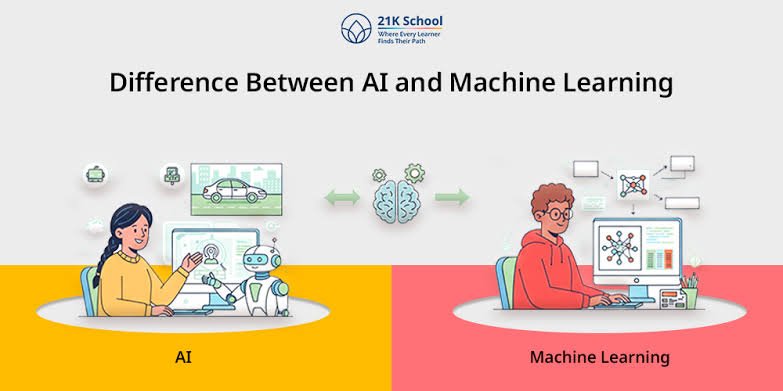
Artificial Intelligence has become one of the most talked-about technologies in the world. From chatbots and virtual assistants to recommendation systems, self-driving technology, fraud detection, and image recognition, AI is increasingly influencing the way people live and work.
At the same time, another term frequently appears alongside Artificial Intelligence: Machine Learning.
People often use “Artificial Intelligence” and “Machine Learning” as if they mean exactly the same thing. However, they are related but different concepts.
Understanding the difference between AI and Machine Learning is important because these technologies are used in many different ways. Machine Learning is one of the major techniques used to build AI systems, but AI is a much broader concept.
So, what exactly is Artificial Intelligence? What is Machine Learning? How are they connected, and which one is more powerful?
This beginner-friendly guide explains the differences in simple terms.
What Is Artificial Intelligence?
Artificial Intelligence (AI) is a broad field of technology focused on creating computer systems that can perform tasks that normally require aspects of human intelligence.
These tasks can include:
- Understanding language
- Recognizing images
- Solving problems
- Making predictions
- Planning
- Reasoning
- Learning from information
- Making decisions
- Generating content
The goal of AI is not necessarily to copy humans perfectly. Instead, AI systems are designed to perform specific tasks that involve forms of intelligence.
For example, an AI system might recognize objects in a photograph, translate a sentence between languages, recommend a movie, or help a customer through a chatbot.
AI can be built using many different techniques, including Machine Learning, neural networks, computer vision, natural language processing, and rule-based systems.
What Is Machine Learning?
Machine Learning (ML) is a subset of Artificial Intelligence.
Instead of programming a computer with explicit instructions for every possible situation, Machine Learning allows systems to learn patterns from data and use those patterns to make predictions or decisions.
Consider a simple example involving email spam.
A traditional program might contain manually written rules such as:
“If an email contains certain words, classify it as spam.”
A Machine Learning system can instead be trained using many examples of spam and legitimate emails.
The system analyzes the examples and learns patterns that help it distinguish between the two categories.
When a new email arrives, the trained model can use what it learned to predict whether the message is likely to be spam.
This ability to learn patterns from data is one of the defining characteristics of Machine Learning.
The Simplest Way to Understand the Difference
A useful way to think about the relationship is:
Artificial Intelligence is the broader concept. Machine Learning is one way of achieving AI.
Imagine Artificial Intelligence as a large umbrella.
Under that umbrella are various technologies and techniques, including Machine Learning.
Machine Learning itself contains different approaches, such as supervised learning, unsupervised learning, and reinforcement learning.
Therefore:
AI → Machine Learning → Machine Learning techniques and models
Not every AI system necessarily has to use Machine Learning, although modern AI increasingly relies heavily on it.
An Everyday Example
Imagine a smartphone’s face-recognition feature.
The overall goal—recognizing the person using the phone—is an AI task.
Machine Learning can be used to train a model to recognize patterns in facial images.
During training, the model may process many examples and learn characteristics that help distinguish one face from another.
Once trained, the system can analyze a new image and make a prediction about whose face it is.
The complete system is an AI application, while Machine Learning may be one of the technologies used to make it work.
How Does Machine Learning Work?
Machine Learning generally involves data, an algorithm, a model, and a training process.
1. Collecting Data
Machine Learning systems need data from which they can learn.
Depending on the application, this could include:
- Images
- Text
- Audio
- Video
- Numbers
- Sensor measurements
- Customer behavior
- Historical records
The quality of the data is extremely important.
Poor-quality or biased data can result in poor or biased predictions.
2. Training a Model
During training, a Machine Learning algorithm analyzes data and identifies patterns.
The system adjusts its internal parameters to improve its performance on the task.
For example, a model designed to recognize cats and dogs could be trained using many labeled photographs.
Over time, it learns patterns associated with each category.
3. Testing
After training, the model is tested using data it did not use during training.
This helps determine whether the model has learned useful patterns or simply memorized the training examples.
4. Making Predictions
Once a model has been trained and evaluated, it can be used with new data.
For example, a trained image-recognition model can receive a new photograph and predict what objects it contains.
Types of Machine Learning
Machine Learning is not a single technique. There are several major approaches.
Supervised Learning
In supervised learning, a model learns from labeled examples.
For example, a system might receive thousands of photographs labeled “cat” or “dog.”
The model learns the relationship between the images and their labels.
Supervised learning is commonly used for classification and prediction tasks.
Examples include:
- Spam detection
- Image classification
- Credit-risk prediction
- Price prediction
- Fraud detection
Unsupervised Learning
In unsupervised learning, the system works with data that does not have predefined labels.
The algorithm attempts to discover patterns or groups within the information.
For example, a business could use unsupervised learning to identify groups of customers with similar purchasing behavior.
This can help organizations discover patterns they did not know existed.
Reinforcement Learning
In reinforcement learning, an AI system learns by interacting with an environment.
The system receives rewards or penalties based on its actions and attempts to learn a strategy that produces better results.
This approach has been used in areas such as game-playing systems, robotics, and decision-making research.
What Are Neural Networks?
Neural networks are another important concept in modern AI and Machine Learning.
A neural network is a computational model inspired loosely by the structure of biological brains.
It contains interconnected mathematical units organized into layers.
Neural networks can learn complex patterns from data.
They are particularly important in modern AI applications involving images, language, speech, and other complicated data.
What Is Deep Learning?
Deep Learning is a specialized form of Machine Learning that uses neural networks with many layers.
Deep Learning has contributed significantly to advances in modern AI.
It has been used for:
- Image recognition
- Speech recognition
- Language processing
- Recommendation systems
- Autonomous systems
- Generative AI
Large neural networks trained on enormous datasets can learn highly complex patterns.
This has helped make modern AI systems much more capable than many earlier systems.
AI vs. Machine Learning: Key Differences
Although AI and Machine Learning are closely connected, there are important differences.
| Artificial Intelligence | Machine Learning |
|---|---|
| Broad field of technology | Subfield of AI |
| Focuses on creating intelligent systems | Focuses on learning patterns from data |
| Can use different approaches | Primarily relies on data-driven learning algorithms |
| Includes reasoning, planning, perception, and generation | Commonly focuses on prediction and pattern recognition |
| Can include rule-based systems | Learns from examples and data |
The easiest distinction is that AI describes the larger goal and field, while Machine Learning describes a major approach used to create intelligent systems.
Generative AI and Machine Learning
Modern generative AI systems have made the relationship between AI and Machine Learning even more visible.
Generative AI can create new content such as:
- Text
- Images
- Audio
- Video
- Computer code
Many modern generative AI systems are built using advanced Machine Learning techniques, particularly Deep Learning and large neural networks.
For example, a language model can be trained on large amounts of text and learn statistical patterns in language.
When a user provides a prompt, the model generates a response based on what it learned during training and the context provided.
Generative AI is therefore part of the broader AI field and relies heavily on Machine Learning.
Examples of Artificial Intelligence
AI is already present in many everyday applications.
Virtual Assistants
Digital assistants can understand spoken or written requests and provide information or perform certain tasks.
Recommendation Systems
Streaming platforms, shopping websites, and social networks can use AI and Machine Learning to recommend content or products.
Navigation
Navigation applications can analyze traffic and other information to estimate travel times and suggest routes.
Fraud Detection
Financial institutions can use Machine Learning to identify unusual patterns that may indicate fraudulent activity.
Medical Imaging
AI systems can assist with the analysis of medical images and help identify patterns that may require further examination.
Customer Service
AI chatbots can answer common questions and help users navigate customer-service systems.
Which Is More Powerful: AI or Machine Learning?
This question is based on a misunderstanding because AI and Machine Learning are not competing technologies.
Machine Learning is part of AI.
Asking which is more powerful is similar to asking whether a vehicle or its engine is more powerful. They are related, but they describe different levels of the system.
AI is the broader field, while Machine Learning is one of the major technologies used within it.
Advantages of Machine Learning
Machine Learning can provide several important benefits.
Automation
It can automate tasks that involve recognizing patterns or making predictions.
Scalability
Once trained, a model can process very large amounts of data.
Adaptability
Some Machine Learning systems can be retrained or updated as new data becomes available.
Pattern Recognition
Machine Learning can identify patterns in complex datasets that may be difficult for humans to detect manually.
Personalization
Companies can use Machine Learning to personalize recommendations and experiences.
Limitations of AI and Machine Learning
Despite their impressive capabilities, AI and Machine Learning have limitations.
AI Can Make Mistakes
An AI system can produce incorrect results.
A confident-looking answer is not necessarily a correct answer.
Data Quality Matters
Machine Learning depends heavily on the quality of its training data.
If the data is incomplete, inaccurate, or biased, the resulting model may also have problems.
Lack of Human Understanding
AI systems can process patterns extremely well, but that does not mean they understand the world in the same way humans do.
Privacy Concerns
AI systems can process large amounts of personal information, creating important privacy and security questions.
Cost and Complexity
Training and operating advanced AI systems can require significant computing resources, specialized expertise, and infrastructure.
Why Is the Difference Important?
Understanding the distinction between AI and Machine Learning is useful for students, professionals, business owners, and anyone interested in technology.
When someone says a company is “using AI,” that could refer to many different technologies.
If a company says it is using Machine Learning, it generally means that algorithms are being trained using data to identify patterns or make predictions.
Knowing this difference can make technology discussions easier to understand and can help people evaluate AI products more realistically.
The Future of AI and Machine Learning
AI and Machine Learning are likely to become even more integrated into everyday technology.
Future systems may become better at understanding language, images, audio, video, and real-world environments.
AI assistants may become more capable of completing multi-step tasks.
Businesses may use Machine Learning more extensively for forecasting, customer service, cybersecurity, logistics, and decision support.
Robotics could also benefit from advances in AI, allowing machines to better understand and respond to their environments.
However, technological progress will also raise important questions about privacy, employment, bias, safety, copyright, and responsible use.
The development of AI will therefore require not only better technology but also thoughtful policies and human oversight.
How Should Beginners Start Learning?
Someone interested in AI does not necessarily need to become an expert programmer immediately.
A good starting point is learning the basic concepts:
- What AI means
- What Machine Learning means
- How data is used
- What algorithms do
- What neural networks are
- How models are trained
- Why AI systems make mistakes
- How to evaluate AI-generated information
Beginners who are interested in programming can eventually explore languages such as Python and libraries commonly used in Machine Learning.
But understanding the concepts is more important than memorizing tools.
Conclusion
Artificial Intelligence and Machine Learning are closely related, but they are not the same thing.
Artificial Intelligence is the broader field focused on creating systems capable of performing tasks associated with intelligence. Machine Learning is a major branch of AI that allows computers to learn patterns from data and use those patterns to make predictions or decisions.
Deep Learning, neural networks, computer vision, natural language processing, and generative AI are all important parts of the modern AI landscape.
The distinction can be summarized simply:
AI is the broader field. Machine Learning is one of the main ways we build AI systems.
As AI continues to develop, understanding this relationship will become increasingly important. Whether you are a student learning about technology, a professional considering AI for work, or simply someone curious about the future, knowing the difference between AI and Machine Learning provides a strong foundation for understanding one of the most important areas of modern technology.