Mobile technology has changed the way people communicate, work, study, shop, travel, and entertain themselves. From the early days of basic mobile phones to today’s smartphones, each generation of wireless technology has brought faster speeds and new capabilities.
The latest major generation of mobile networks is 5G, short for fifth-generation wireless technology. 5G was designed to provide faster data speeds, lower latency, greater network capacity, and improved support for large numbers of connected devices.
While 4G made smartphones capable of delivering high-quality video, mobile applications, online gaming, and other data-intensive services, 5G is designed to support an even broader range of applications. These include connected vehicles, smart cities, industrial automation, augmented and virtual reality, and increasingly sophisticated Internet of Things devices.
But what exactly is 5G, and how is it different from 4G? Is it really better, and how does it affect ordinary users?
This beginner-friendly guide explains everything you need to know about 5G technology and its advantages over 4G.
What Is 5G?
5G is the fifth generation of cellular wireless technology.
It is designed to provide improvements in several important areas, including:
- Faster data speeds
- Lower latency
- Greater network capacity
- Better support for connected devices
- More efficient use of wireless spectrum
- Improved performance in crowded locations
Like previous generations of mobile networks, 5G allows phones and other wireless devices to communicate with cellular network infrastructure.
However, 5G is more than simply a faster version of 4G. It introduces new technologies and network architectures designed to support a much wider variety of applications.
A Brief History of Mobile Networks
To understand 5G, it helps to understand how cellular networks have developed.
1G introduced basic analog mobile voice communication.
2G brought digital communication and services such as text messaging.
3G made mobile internet access more practical and supported early mobile applications and video services.
4G dramatically improved mobile data performance. It helped make smartphones truly powerful internet-connected devices and enabled services such as high-quality video streaming, social media, mobile gaming, video calling, and cloud-based applications.
5G builds on these generations while aiming to provide significantly better performance and support new categories of connected technology.
Each generation did not simply make phones faster. It expanded what mobile networks could be used for.
How Does 5G Work?
5G uses a combination of technologies and frequency bands to transmit information wirelessly.
One important aspect of 5G is that it can operate across different parts of the radio spectrum.
Some 5G networks use relatively low-frequency spectrum. These signals can travel long distances and penetrate buildings relatively well.
Other 5G networks use higher-frequency spectrum, including millimeter-wave frequencies. These can provide extremely high capacity and fast speeds but generally have shorter range and can be more affected by physical obstacles.
Between these extremes are mid-band frequencies, which can provide a useful balance between coverage, capacity, and speed.
This combination allows network operators to design 5G networks for different environments and requirements.
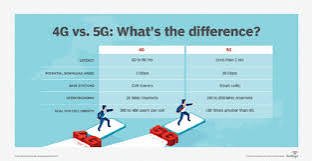
5G vs. 4G: What Is the Difference?
The most obvious difference between 5G and 4G is speed, but speed is only one part of the story.
1. 5G Can Be Faster
5G can provide significantly higher speeds than many 4G connections.
Faster connections can make it easier to download large files, stream high-quality video, use cloud applications, and perform other data-intensive tasks.
However, actual speeds vary considerably depending on factors such as the network operator, frequency band, location, signal strength, network congestion, and device.
Therefore, users should not expect every 5G connection to operate at the maximum theoretical speed.
2. 5G Has Lower Latency
Latency is the time it takes for data to travel between a device and a network destination.
Lower latency means a system can respond more quickly.
This is important for applications where immediate responses matter.
For example, online gaming can benefit from lower latency because actions can be transmitted and received more quickly.
Low latency can also be important for industrial automation, remote-control systems, connected vehicles, and interactive augmented or virtual reality applications.
4G can already provide relatively low latency, but 5G was designed to reduce it further under appropriate network conditions.
3. 5G Supports More Connected Devices
Modern society is becoming increasingly connected.
People have smartphones, smartwatches, tablets, laptops, smart TVs, security cameras, home appliances, vehicles, sensors, and other connected devices.
A network must be able to handle huge numbers of devices without becoming overwhelmed.
5G is designed to support much greater device density, making it particularly useful for the Internet of Things (IoT).
For example, a smart city could potentially contain large numbers of connected sensors monitoring traffic, environmental conditions, energy consumption, parking, and public infrastructure.
4. 5G Can Perform Better in Crowded Locations
Large events, shopping centers, airports, stadiums, and city centers can contain enormous numbers of connected devices.
4G networks can become congested when many users attempt to access them simultaneously.
5G introduces technologies designed to improve capacity and efficiency.
This can help networks handle large numbers of users and devices in densely populated environments.
The exact experience still depends on how well a particular network has been designed and deployed.
5. 5G Enables New Applications
Perhaps the most important difference is not what 5G does for smartphones, but what it can enable beyond smartphones.
5G can support applications involving:
- Smart cities
- Autonomous and connected vehicles
- Industrial automation
- Remote monitoring
- Smart factories
- Augmented reality
- Virtual reality
- Robotics
- Massive IoT deployments
- Advanced healthcare technologies
These applications may require combinations of speed, reliability, low latency, and network capacity.
Benefits of 5G for Everyday Users
For ordinary smartphone users, the advantages of 5G can include faster downloads, smoother high-quality streaming, improved performance in crowded areas, and quicker responses from online services.
Imagine downloading a large file while traveling or streaming a high-resolution video without waiting for it to buffer.
In a well-designed 5G network with a compatible device and strong coverage, these activities can feel noticeably faster.
However, the difference between 4G and 5G may not always be obvious for simple activities such as sending messages, reading emails, or browsing ordinary websites.
If a 4G connection is already fast enough for a particular activity, moving to 5G may not produce a dramatic improvement.
5G and Gaming
Mobile gaming is another area that can benefit from 5G.
Fast speeds can help users download games and updates more quickly, while lower latency can improve responsiveness in online games.
5G may also support cloud gaming, where games are processed on remote servers and streamed to a user’s device.
This approach can reduce the need for extremely powerful hardware on the user’s device.
However, cloud gaming depends on more than just download speed. Consistent latency and network stability are also important.
5G and Streaming
Streaming services have become a major part of modern entertainment.
5G can make it easier to stream high-resolution video while away from a home broadband connection.
As video quality increases, the amount of data required also increases. Faster mobile networks can help support these demands.
5G can also support emerging immersive technologies such as augmented and virtual reality, although the quality of these experiences depends on many factors beyond the network.
5G and the Internet of Things
The Internet of Things refers to physical objects that contain sensors, software, and connectivity so that they can exchange information.
Examples include:
- Smart thermostats
- Industrial sensors
- Connected vehicles
- Smart meters
- Wearable devices
- Security systems
- Agricultural sensors
5G can support large-scale IoT deployments by providing connectivity for many devices.
For example, a farm could use connected sensors to monitor soil conditions, temperature, moisture, and equipment.
A factory could use sensors to monitor machinery and identify potential problems before equipment fails.
5G and Smart Cities
5G could also contribute to the development of smarter cities.
Cities generate enormous amounts of information every day. Sensors can potentially monitor traffic, parking, public transportation, environmental conditions, lighting, energy use, and infrastructure.
Connected systems could then use this information to improve efficiency.
For example, traffic signals could potentially respond to changing traffic patterns. Street lighting could adjust according to conditions. Parking systems could provide real-time information about available spaces.
5G is not the only technology required to create a smart city, but it can provide an important communications layer.
5G and Healthcare
Healthcare is another potential area of 5G innovation.
High-speed, low-latency connectivity can support connected medical devices, remote monitoring, telemedicine, and other applications.
Doctors and healthcare organizations can increasingly use digital tools to communicate with patients and share information.
In specialized environments, reliable connectivity could also support advanced equipment and remote-control applications.
However, healthcare applications require extremely high standards for reliability, privacy, safety, and security. 5G alone does not solve these challenges.
5G and Connected Vehicles
Vehicles are becoming increasingly connected.
Cars can communicate with cloud services, navigation systems, other vehicles, and infrastructure.
5G can support fast communication between vehicles and networks, potentially helping develop more advanced transportation systems.
For example, connected vehicles could exchange information about traffic conditions, road hazards, and other events.
Autonomous driving is a much more complicated problem, however. It depends on sensors, artificial intelligence, mapping, computing, vehicle systems, and many other technologies. 5G can support connected-vehicle applications, but it is not by itself the technology that makes a vehicle autonomous.
Is 5G Always Better Than 4G?
In many situations, 5G can provide better performance than 4G. However, that does not mean 5G is always faster or better in every location.
The experience depends on:
- Network coverage
- Frequency band
- Distance from the cell site
- Network congestion
- Device capabilities
- Building materials
- Weather and environmental conditions
- Network configuration
A strong 4G connection can sometimes perform better than a weak 5G connection.
This is especially relevant because higher-frequency 5G signals generally have shorter ranges and can be more easily blocked by physical obstacles.
What Do You Need to Use 5G?
To use a 5G mobile network, you generally need three things.
First, you need a 5G-compatible device.
Second, you need a mobile plan that provides access to the operator’s 5G network.
Third, you need to be in an area where compatible 5G coverage is available.
If any of these conditions is missing, your device may use 4G or another available network technology instead.
Does 5G Replace Wi-Fi?
No.
5G and Wi-Fi serve different purposes.
5G provides cellular connectivity over relatively large geographic areas. Wi-Fi is generally used to connect devices to a local network.
At home, for example, your phone might connect to Wi-Fi through your broadband connection. When you leave home, it can switch to a cellular network.
In some situations, 5G can serve as an alternative to traditional fixed broadband through fixed wireless access, where a cellular network provides internet connectivity to a home or business.
However, Wi-Fi remains extremely important for local connectivity.
Security and Privacy Concerns
As more devices become connected, security becomes increasingly important.
A larger number of connected devices creates more potential targets for cybercriminals.
5G networks therefore need strong security measures, and users should continue following good cybersecurity practices.
People should keep devices updated, use strong passwords, enable multi-factor authentication where appropriate, and be careful about the applications and services they connect to their devices.
Privacy is also important because connected devices can generate large amounts of information.
Organizations need to handle this data responsibly and protect it from unauthorized access.
The Future of 5G
The impact of 5G will likely become clearer as networks mature and more applications are developed.
The technology is not simply about faster smartphones. Its larger significance lies in connecting enormous numbers of devices and supporting applications that require high performance and reliable wireless communication.
As 5G networks expand, businesses and developers may discover new applications that were difficult or impractical with earlier generations.
At the same time, future wireless technologies will continue to develop, and research into the next generation of mobile communication is already underway.
Conclusion
5G is the fifth generation of cellular wireless technology. It is designed to provide faster speeds, lower latency, greater capacity, and better support for large numbers of connected devices.
Compared with 4G, 5G can provide significant improvements for activities such as high-quality streaming, mobile gaming, large file transfers, and cloud-based applications. More importantly, it can support emerging technologies such as connected vehicles, smart cities, industrial automation, robotics, and large-scale Internet of Things systems.
However, 5G is not automatically faster everywhere. Performance depends on network coverage, frequency bands, device capabilities, congestion, and other environmental factors.
For everyday users, the transition from 4G to 5G may sometimes be noticeable and sometimes barely visible. For businesses and technology developers, however, the technology could have a much broader impact.
Ultimately, 5G represents more than the next generation of mobile internet. It is part of a larger shift toward a world in which people, machines, vehicles, sensors, and digital services are increasingly connected. As these connections become faster and more reliable, 5G could become an important foundation for the next generation of digital technology.