When most people hear the word blockchain, they immediately think of Bitcoin, cryptocurrency, or digital assets. Cryptocurrency was one of the first major applications of blockchain technology, but blockchain itself is much broader.
At its core, blockchain is a method of recording and sharing information across a network in a way that can make records difficult to alter without detection. This feature has attracted attention from industries ranging from finance and healthcare to supply chains, entertainment, government, and education.
Blockchain has the potential to change how organizations store records, verify transactions, establish trust, and exchange information.
But what exactly is blockchain? How does it work? Why was it created, and how can it be used for purposes beyond cryptocurrency?
This beginner-friendly guide explains blockchain technology and explores some of its most important applications outside the world of digital currencies.
What Is Blockchain?
A blockchain is a type of distributed digital ledger.
A ledger is simply a record of transactions or information. Traditionally, a bank, company, government agency, or other central organization might maintain such a record.
With blockchain, copies of the ledger can be maintained across multiple computers in a network.
Information is generally organized into groups called blocks. These blocks are connected together in chronological order, forming a chain.
Hence the name:
Block + Chain = Blockchain
Each block can contain information about transactions or other records, depending on how the blockchain is designed.
How Does Blockchain Work?
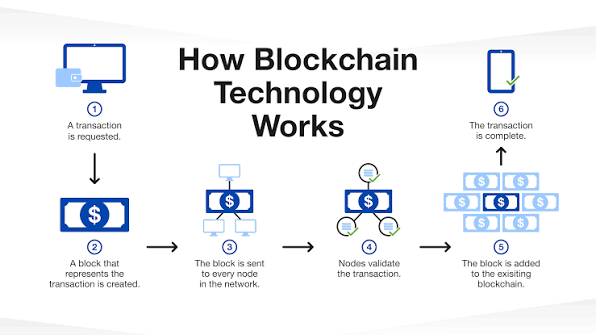
Although blockchain systems can be technically complicated, the basic concept can be explained in a few steps.
1. A Transaction or Record Is Created
Someone initiates an action that needs to be recorded.
For example, this could be a financial transaction, the transfer of ownership of a digital asset, or the recording of information about a product.
2. The Information Is Shared With the Network
The proposed transaction is distributed to computers participating in the blockchain network.
These computers are commonly referred to as nodes.
3. The Network Validates the Information
The network uses a set of rules, often called a consensus mechanism, to determine whether the transaction is valid.
Different blockchains use different approaches to reach agreement.
4. Transactions Are Grouped Into a Block
Validated transactions can be collected together into a block.
5. The Block Is Added to the Chain
The new block is connected to previous blocks.
Cryptographic techniques help create relationships between blocks and make unauthorized changes easier to detect.
6. The Ledger Is Updated
Participating computers update their records according to the network’s rules.
This creates a shared record of activity.
What Makes Blockchain Different?
One of blockchain’s most important characteristics is that it can operate without relying entirely on one central authority to maintain the record.
Traditional systems often work like this:
Person → Central Organization → Record
A blockchain-based system may instead operate more like:
Participant → Network → Shared Record
This does not mean that every blockchain is completely decentralized. Some blockchains are controlled by specific organizations or groups.
The level of decentralization depends on the design of the system.
What Is Decentralization?
Decentralization means distributing control or responsibility across multiple participants rather than placing everything under one central authority.
Imagine a company keeping a database on one server.
If the server is compromised or the database is changed, the organization has to rely on its backup and security systems.
A blockchain network can distribute copies of information across multiple participants.
This can make the system more resilient, depending on its architecture.
Decentralization can also reduce dependence on a single organization.
However, decentralization is not automatically better for every situation. Centralized databases can be faster, simpler, cheaper, and easier to manage for many applications.
The right technology depends on the problem being solved.
Blockchain Is More Than Cryptocurrency
Cryptocurrency is simply one application of blockchain technology.
Blockchain can potentially be used whenever multiple parties need to maintain a shared record and want mechanisms for verifying changes.
Some of the most interesting applications are outside cryptocurrency.
1. Supply Chain Management
Supply chains can involve many organizations.
A product may move from a manufacturer to a distributor, then to a retailer, and finally to a customer.
Keeping accurate records across all these stages can be difficult.
Blockchain can provide a shared record of certain supply-chain events.
For example, information about a product could be recorded as it moves through different stages.
Depending on the system, users could potentially verify:
- Where a product came from
- When it was manufactured
- When it was shipped
- Which organizations handled it
- When it arrived at a particular location
This could improve traceability.
For example, if a food-safety problem occurs, better records could help organizations identify where a product came from and where it traveled.
However, blockchain does not automatically guarantee that the information entered into the system is true. If someone enters false information at the beginning, blockchain technology can preserve that false information very effectively.
This is known as the “garbage in, garbage out” problem.
2. Healthcare Records
Healthcare organizations manage enormous amounts of sensitive information.
Patients may receive treatment from multiple doctors, hospitals, pharmacies, laboratories, and insurance providers.
Blockchain technology could potentially help organizations coordinate certain types of records and permissions.
For example, a blockchain-based system might record authorization for particular organizations to access specific information.
The actual medical data does not necessarily have to be stored directly on a blockchain. Because blockchains can be difficult to modify and may expose transaction information to participants, sensitive health data may instead be stored securely elsewhere, with the blockchain used for verification or access records.
Healthcare blockchain systems therefore require careful attention to privacy, security, and regulations.
3. Digital Identity
Digital identity is another potential application.
Today, people often have separate accounts and identity records across many websites and organizations.
Blockchain-based identity systems could potentially allow individuals to control verified digital credentials.
For example, a person might have a digital credential proving that they hold a particular qualification.
Instead of repeatedly submitting documents, they could potentially share a verifiable digital credential with an organization.
This concept is sometimes associated with self-sovereign identity, where individuals have greater control over their digital identity information.
However, widespread digital identity systems must address privacy, security, usability, and legal recognition.
4. Voting Systems
Blockchain has also been proposed for electronic voting.
A blockchain-based voting system could potentially create an auditable record of votes while making unauthorized modifications more difficult.
Supporters argue that blockchain could improve transparency and help create verifiable election records.
However, elections involve much more than simply recording votes.
A secure voting system must protect voter privacy, prevent coercion, verify voter eligibility, resist cyberattacks, and ensure that votes are accurately counted.
Blockchain alone does not solve these problems.
Therefore, blockchain-based voting remains a complicated and debated application rather than a simple solution.
5. Intellectual Property and Copyright
Creators often need to prove when they created or published something.
Blockchain could potentially be used to create a timestamped record associated with a digital work.
For example, an artist could record information about a piece of artwork or a document on a blockchain.
This could help establish evidence that a particular record existed at a certain time.
Blockchain can also support digital ownership systems and smart contracts.
However, recording ownership information on a blockchain does not automatically establish legal ownership. Legal rights still depend on contracts, laws, and relevant institutions.
6. Digital Certificates and Education
Educational institutions issue certificates, diplomas, and professional credentials.
Verifying these documents can sometimes be difficult, especially when employers or institutions need to confirm whether a credential is genuine.
Blockchain could support systems for issuing verifiable digital credentials.
A university, for example, could issue a digital certificate that contains information allowing another organization to verify its authenticity.
This could reduce the need for manual verification.
It could also make it easier for individuals to share educational achievements with employers or other institutions.
7. Real Estate
Buying and selling property involves many records, organizations, and legal processes.
Blockchain could potentially be used to record certain aspects of property transactions.
For example, a blockchain system could maintain a tamper-evident history of transactions associated with a property.
Smart contracts could also automate certain parts of a transaction when predefined conditions are satisfied.
However, real estate transactions involve legal ownership, government records, financial institutions, and other requirements. Blockchain cannot replace these systems by itself.
8. Smart Contracts
One of the most important blockchain concepts beyond basic recordkeeping is the smart contract.
A smart contract is software stored and executed on a blockchain that can automatically perform actions when specified conditions are met.
Imagine a simple agreement:
“If condition X happens, perform action Y.”
The software can enforce the programmed rules automatically.
Smart contracts can potentially be used for:
- Payments
- Digital assets
- Insurance applications
- Financial services
- Automated agreements
- Decentralized applications
The advantage is that some processes can operate automatically without requiring an intermediary to manually execute every step.
However, smart contracts are still computer programs. Bugs or poorly designed logic can produce unexpected results.
9. Gaming
Blockchain technology has also entered the gaming industry.
Some blockchain-based games allow players to own digital assets represented through blockchain technology.
These assets can potentially be transferred between users or used across compatible systems.
The idea is different from traditional games, where digital items are usually controlled entirely by the game publisher.
However, blockchain gaming has faced criticism and practical challenges involving usability, economics, security, and whether blockchain actually improves the gaming experience.
The technology may have useful applications, but it is not automatically beneficial simply because it uses a blockchain.
10. Entertainment and Digital Content
Blockchain can potentially help creators manage digital rights and transactions.
Musicians, artists, writers, and other creators could use blockchain-based systems to record information about digital works, manage transactions, or distribute certain types of digital assets.
Blockchain-based payment systems could potentially automate royalty distributions under predefined conditions.
Again, the usefulness depends on how the system is designed and whether it solves a real problem better than existing technologies.
What Are the Benefits of Blockchain?
Blockchain can provide several potential advantages.
Transparency
Some blockchain networks allow participants to inspect transaction histories.
Traceability
Records can provide a history of activity associated with an asset or transaction.
Tamper Resistance
Once information is confirmed and added to a blockchain, changing it can be difficult depending on the system’s design.
Reduced Dependence on Intermediaries
Certain blockchain applications can automate transactions and reduce the need for some intermediaries.
Shared Records
Multiple organizations can potentially work from a common record instead of maintaining completely separate databases.
What Are the Disadvantages?
Blockchain is not a perfect solution.
Complexity
Blockchain systems can be difficult to design, operate, and understand.
Performance
Some blockchains may process transactions more slowly than traditional centralized databases.
Energy Consumption
Certain consensus mechanisms can require significant amounts of energy. Other blockchain designs use considerably less energy.
Therefore, energy use depends heavily on the specific blockchain architecture.
Privacy
Blockchain records can create privacy challenges, especially when information is permanently or publicly recorded.
Irreversibility
In some systems, transactions are difficult or impossible to reverse.
This can be beneficial for record integrity but problematic when mistakes occur.
Regulation
Blockchain applications can create complicated legal and regulatory questions.
Blockchain vs. Traditional Databases
A blockchain is not necessarily a replacement for a normal database.
Traditional databases are often better when one trusted organization needs to manage information efficiently.
A blockchain may make more sense when multiple parties need to share a record and do not want to rely entirely on one central organization.
A simple way to think about the distinction is:
Traditional database: efficient centralized recordkeeping.
Blockchain: shared recordkeeping with cryptographic verification and, in some designs, decentralized control.
Organizations should therefore choose blockchain because it solves a specific problem—not simply because blockchain is a popular technology.
The Future of Blockchain
Blockchain technology is still developing.
Some applications may disappear because they do not provide enough value. Others may become important parts of financial systems, digital identity, supply chains, entertainment, and business infrastructure.
Future blockchain systems may become faster, more energy efficient, easier to use, and better integrated with existing technologies.
Blockchain may also increasingly work alongside technologies such as artificial intelligence, cloud computing, the Internet of Things, and cybersecurity systems.
The most successful applications will probably be those that provide clear practical benefits rather than simply using blockchain for marketing purposes.
Conclusion
Blockchain is a technology for maintaining digital records across a network using cryptographic techniques and agreed-upon rules.
Although cryptocurrency helped make blockchain famous, its potential applications extend far beyond digital currencies.
Supply-chain tracking, healthcare information, digital identity, education credentials, smart contracts, intellectual property, real estate, gaming, and entertainment are just some of the areas where blockchain has been explored.
At the same time, blockchain is not a universal solution. It can introduce challenges involving cost, speed, privacy, energy consumption, security, regulation, and complexity.
The most important lesson is that blockchain is a tool, not an answer to every technology problem.
When used appropriately, it can provide new ways to create shared, verifiable records and automate transactions between organizations and individuals.